Cart
0
Checking your FREE GIFT offer...


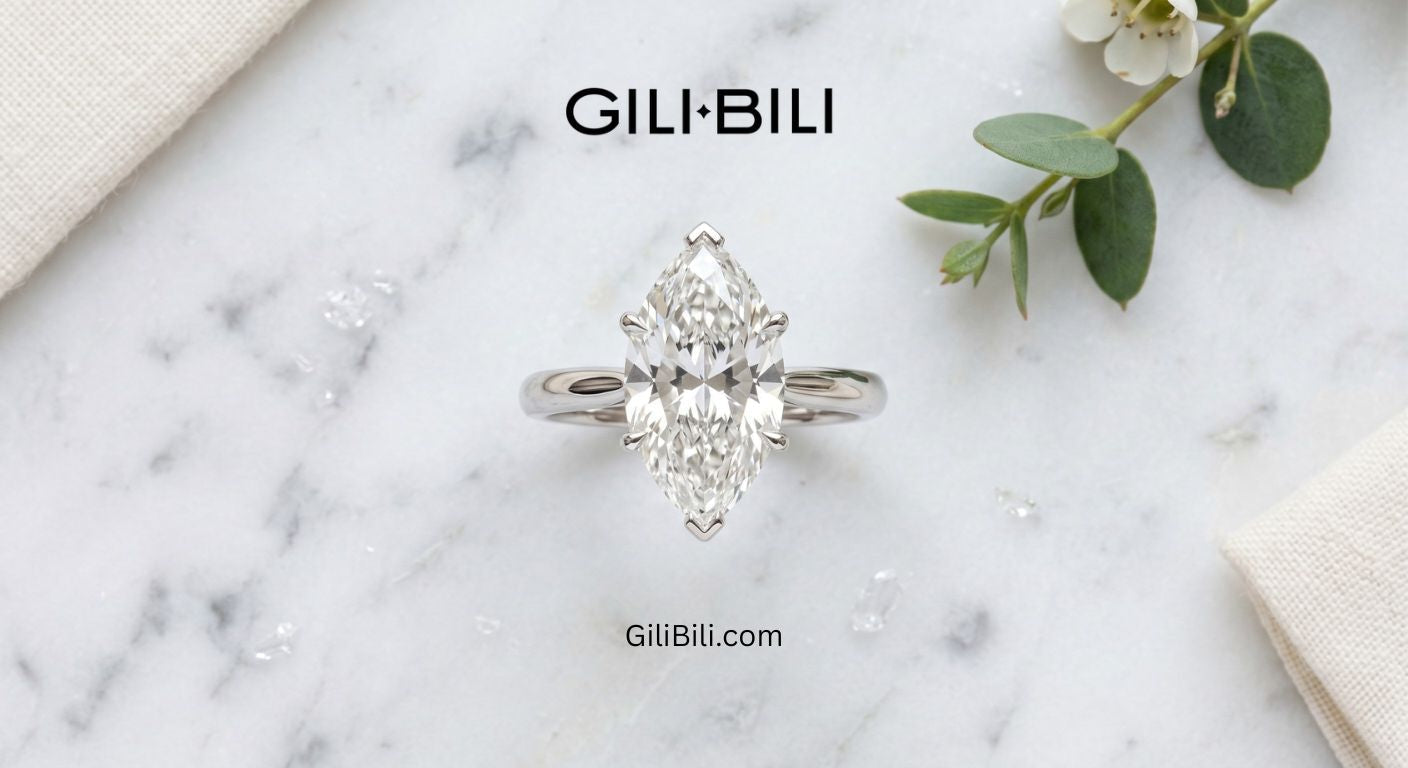
If you are searching for a ring that looks dramatically larger than its carat weight suggests, the 3 carat marquise shape diamond ring is one of the smartest choices you can make. With its elongated silhouette and pointed tips, a marquise diamond creates an illusion of size that outperforms almost every other shape at the same carat weight.
I'm Chintan Dhola, co-founder of GiliBili and someone who has spent over 12 years in diamond manufacturing and grading. I work with marquise diamonds regularly, and I genuinely love how they look on the finger. They are bold, elegant and timeless.
In this guide, I'll walk you through exactly what a 3 carat marquise lab-grown diamond looks like, what it costs, and what to watch out for before you buy.

A 3 carat marquise diamond typically measures around 15 x 7.5 mm with an ideal length-to-width ratio between 1.85:1 and 2.10:1. Because of its elongated shape, it sits across more of your finger than a round or cushion, making it look noticeably larger than other 3 carat diamonds sometimes appearing closer to a 4 carat round in visual spread.
The marquise shape, sometimes called the "navette" (French for little boat), has been around since the 18th century. It was reportedly created for King Louis XV of France, who wanted a diamond that resembled the lips of his favourite companion, the Marchioness de Pompadour.
For a 3 carat stone, here is what to expect:
If the ratio goes above 2.10:1, the diamond starts to look excessively narrow and pointed. Below 1.75:1, it starts to look stubby. For a 3 carat, I personally recommend staying between 1.90:1 and 2.05:1 that's the sweet spot where it looks breathtaking without losing balance.
You can read more about the marquise shape in our full Marquise Shape Lab Diamond Guide.
A high-quality 3 carat marquise lab-grown diamond ring set in 14K or 18K gold with an IGI-certified, D-F color, VS-VVS clarity, Excellent cut stone typically costs between $4,500 and $5,000 USD (approximately £3,690 to £4,100 GBP). This is a fraction of what a comparable natural marquise diamond would cost, which could run $50,000 or more for the same specifications.
Here is what drives the price of your 3 carat marquise ring:
The 4Cs for Marquise Diamonds
Lab vs Natural Pricing
A 3 carat natural marquise diamond with the same specs (D-F, VS-VVS, Excellent) can cost anywhere from $40,000 to $70,000+. The same stone, grown in a lab with identical chemical, optical and physical properties, is a fraction of that. The IGI certification confirms there is no quality difference just a price difference.
See our full 3 Carat Diamond Ring Price Guide for a deeper breakdown.

|
Carat Weight |
Approx. Dimensions (mm) |
Estimated Price Range (USD) |
Lifestyle Fit |
|
2.0 ct |
12.5 x 6.3 mm |
$2,500 – $3,000 |
Elegant everyday wear, noticeable but understated |
|
3.0 ct |
15.0 x 7.5 mm |
$4,500 – $5,000 |
Statement ring, ideal for engagements |
|
4.0 ct |
17.0 x 8.5 mm |
$6,000 – $6,500 |
Bold statement, best for special occasions |
Notice how the price does not jump linearly. Going from 2 to 3 carat more than doubles the cost because larger rough diamonds are rarer even in lab-grown production, and the cutting yield is lower on bigger stones. Going from 3 to 4 carat adds another $1,000 to $1,500, but you gain a diamond that is visually enormous on the hand.
For a comparison of 2 carat and 3 carat options side by side, read our 2 Carat vs 3 Carat Diamond Ring Price guide.
The most important thing to know when buying a 3 carat marquise diamond is how to evaluate the bow-tie effect, tip protection, and symmetry three factors that are unique to this shape and not covered on any grading certificate.
Here are my top tips after years of working with marquise diamonds:
1. Check for the Bow-Tie Effect Every marquise diamond has some degree of a dark bow-tie shaped shadow across its center. A slight bow-tie adds depth. A strong bow-tie looks like a dark patch and kills the brilliance. Always ask for a video of the stone under different lighting before purchasing.
2. Protect Those Tips The pointed ends of a marquise are the most vulnerable part of the diamond. Make sure your ring setting includes V-shaped prongs at each tip. These prongs protect the point from chipping a marquise tip without protection is a risk.
3. Symmetry Is Everything A marquise must be perfectly symmetrical from point to point. Hold the diamond up and look straight down the center axis. If one lobe looks larger or the tips don't align, pass on that stone.
4. Prioritize VS-VVS Clarity As I mentioned earlier, inclusions near the tips are a structural concern. Always ask specifically where inclusions are located on the stone a VS1 with a feather near the tip is worse than a VS2 with inclusions safely in the center.
5. Go D-F Color Marquise diamonds show color more visibly at the tips. A G color stone might look fine in a round, but in a marquise the tips can show a slight warmth that becomes noticeable in daylight. Stick with D-F for a truly colorless look.
6. Don't Skip the IGI Certificate Every solitaire diamond at GiliBili comes with an IGI certificate and laser inscription. The laser inscription is your security it links the physical stone to its grading report permanently. Learn more about lab-grown diamonds and certification.

The right setting for a 3 carat marquise protects the diamond while maximizing its dramatic visual impact. These are the settings I most often recommend:
Solitaire Setting This is the purest way to show off a marquise. A simple six-prong solitaire (four at the sides, one V-prong at each tip) lets the diamond take center stage. It's timeless, elegant and never goes out of style. Browse our Solitaire Rings collection to see what's possible.
East-West Solitaire Instead of pointing up and down the finger, the diamond is turned 90 degrees horizontally. This is a modern, architectural look that's become very popular in the last few years. The east-west orientation also reduces the risk of tip damage from everyday knocks.
Three-Stone Setting Flanking the marquise with two smaller pear or round diamonds creates a stunning trilogy effect. The side stones add sparkle while keeping focus on the center marquise. Our Three Stone Rings collection has several settings that work beautifully with a marquise center.
Halo Setting A halo of small round diamonds surrounding the marquise amplifies its already impressive size. For a 3 carat marquise, a thin micro-pave halo can make it appear close to a 4 carat stone. Explore our Halo Rings collection for design ideas.
At GiliBili, we can help you create a completely bespoke 3 carat marquise engagement ring from scratch and it's simpler than most people think.
Here's how our custom process works:
You can explore our current Marquise Diamond Engagement Rings collection or visit our Custom Jewelry page to start the conversation.
Not sure what ring size to order? Use our Ring Size Guide before placing your order.
Is a 3 carat marquise diamond too big for everyday wear?
A 3 carat marquise is absolutely wearable daily, but it does require some care. The pointed tips need V-prong protection, and you should avoid wearing the ring during activities like lifting weights or gardening. With the right setting, many customers wear their marquise engagement rings every day without issue.
Does a marquise diamond look bigger than a round at 3 carats?
Yes, a 3 carat marquise diamond looks noticeably larger than a 3 carat round diamond. The elongated shape covers more surface area on your finger, which creates a larger visual impression. A 3 carat marquise can look almost as large as a 3.5 or even 4 carat round diamond at the same table spread.
What finger size suits a 3 carat marquise ring best?
The marquise shape is actually universally flattering because its elongated form makes fingers of all sizes look slender and elegant. Smaller fingers benefit especially the length of the stone creates a beautifully proportioned look. For larger hands, a marquise at 3 carats fills the finger well without looking overwhelming.
What is the ideal length-to-width ratio for a 3 carat marquise?
For a 3 carat marquise diamond, the ideal length-to-width ratio is between 1.85:1 and 2.10:1. This range gives the stone a balanced, elegant appearance elongated enough to show the shape's character, but not so narrow that it looks like a sliver. I personally prefer ratios between 1.90:1 and 2.05:1.
How do I know if my marquise diamond has a bad bow-tie?
You can't tell from the grading report alone. Always request a video of the diamond under different lighting conditions natural daylight, overhead light, and candlelight ideally. A problematic bow-tie will appear as a persistent dark shadow across the center of the stone in most lighting conditions.
Is a lab-grown marquise diamond as good as a natural one?
Yes. A lab-grown marquise diamond has the same chemical composition (pure carbon), the same optical properties (refractive index, dispersion), and the same physical hardness (10 on the Mohs scale) as a natural diamond. The IGI grades them on the same 4C standards. The only difference is origin and price. You can learn more about this on IGI's official website.
If you want a ring that looks dramatic, wears elegantly, and offers exceptional value per carat the 3 carat marquise shape diamond ring is one of the best choices in fine jewelry today.
At D-F color, VS-VVS clarity, Excellent cut and IGI certified, you're getting a stone that rivals anything a natural diamond can offer, at a fraction of the price. The marquise shape takes that value even further by making 3 carats look like so much more on the hand.
Whether you're browsing our 3 Carat Diamond Ring collection or starting from scratch with a custom design, I'd love to help you find the perfect stone.
Connect with us directly:
We help with loose lab diamonds, custom engagement rings, wedding jewelry, and color lab diamonds. No pressure just honest guidance from someone who lives and breathes diamonds every day.


