Cart
0
Checking your FREE GIFT offer...


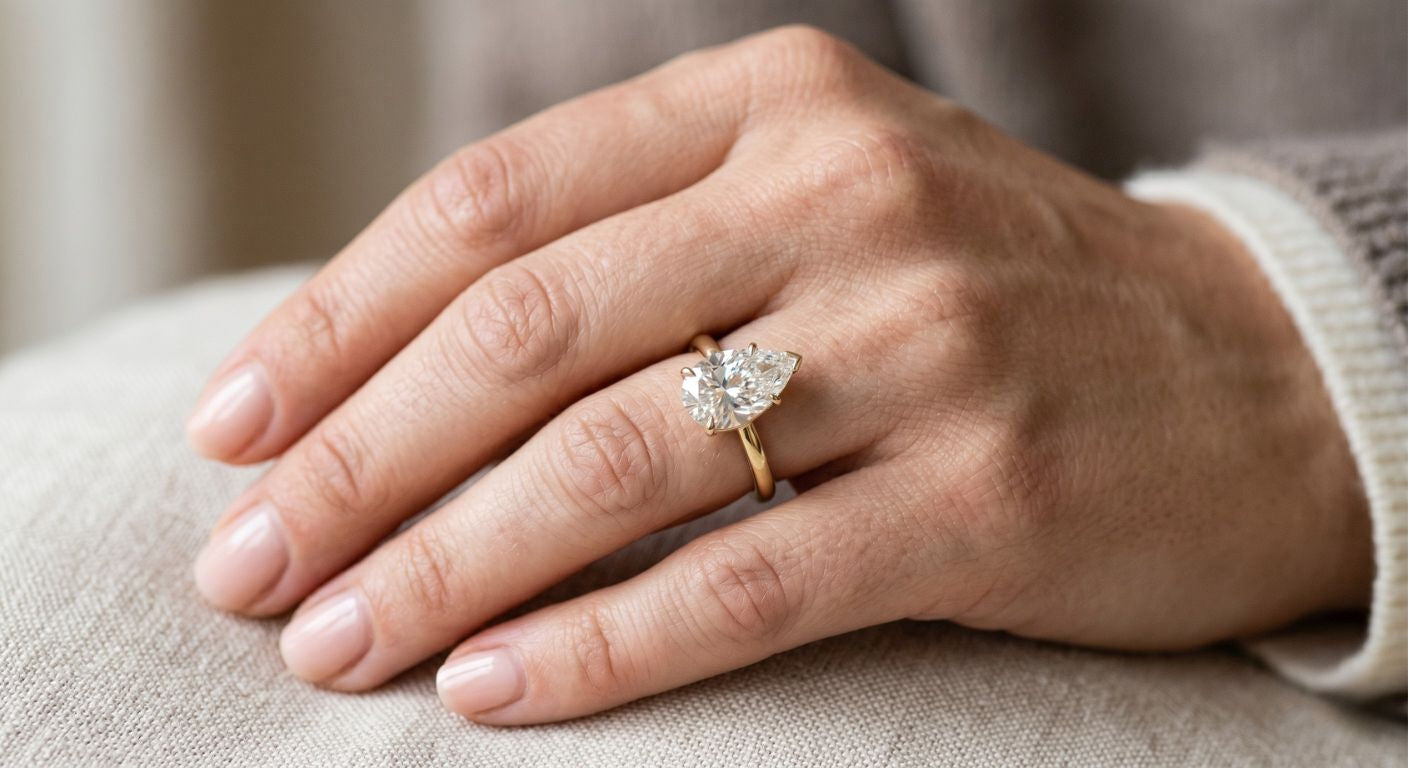
There is something truly iconic about a 3 carat pear shape diamond ring. That teardrop silhouette pointed at one end, gently rounded at the other sits on the finger like nothing else. It is dramatic without trying too hard, and elegant without being cold. I am Chintan Dhola, co-founder of GiliBili and someone who has worked directly in diamond manufacturing and grading for over 12 years. If you are thinking about a 3 carat pear shape diamond ring, you are in the right place.
At this size, you are looking at a premium lab-grown diamond in the $4,500 to $5,000 range for the stone alone, with the finished ring in 14K or 18K gold typically ranging between $5,000 and $5,800. This guide covers everything the actual dimensions, real price breakdowns, buying tips specific to pear shapes, settings, and honest answers to questions I hear every week from customers.
A 3 carat pear shape lab diamond typically measures between 13.0 x 8.5 mm and 14.0 x 9.0 mm depending on its length-to-width ratio. Because of its elongated shape, it covers significantly more surface area than a round diamond of the same carat weight, making it appear visibly larger on the finger.
The pear shape also called a teardrop or pendeloque is one of the most visually generous diamond shapes you can choose. At 3 carats, most pear diamonds land in that 13–14mm length range, which means the stone extends nearly halfway across a standard finger.
What is the ideal length-to-width ratio for a pear diamond?
For a pear, the sweet spot is a length-to-width ratio between 1.50 and 1.75. This range gives you that classic teardrop look not too fat, not too narrow. A ratio under 1.45 starts to look a bit stubby. Over 1.80, and the diamond can appear overly thin and more fragile at the tip.
A 3 carat pear also creates a beautiful elongating effect on the finger. It visually lengthens shorter fingers and adds elegance to longer ones. No other diamond shape quite does that the same way.

A premium 3 carat pear shape lab-grown diamond ring IGI certified, D-F color, VS-VVS clarity, Excellent cut, no fluorescence is priced between $4,500 and $5,500 for the complete ring in 14K or 18K gold. The loose stone alone sits in the $4,500 to $5,000 range, with setting costs adding $500 to $800 depending on the design.
Let me break this down practically.
The 4Cs for a 3 Carat Pear Lab Diamond
At GiliBili, we only work with the highest tier of lab diamonds. For a solitaire pear ring, here is what we specify:
Lab-Grown vs Natural Diamond Price Difference
A natural 3 carat pear diamond at this quality level typically runs $30,000 to $60,000+. A lab-grown version with identical grading? Between $4,500 and $5,500 in a finished gold ring. You are getting the same chemical composition, same optical properties, same IGI grading at a fraction of the cost. That difference in budget can go toward a honeymoon, a home, or a stunning custom setting.
For a broader look at how 3 carat diamond prices compare across shapes, see our 3 Carat Diamond Ring Price Guide.
|
Carat Weight |
Average Dimensions (mm) |
Estimated Price Range (USD) |
Lifestyle Fit |
|
2.0 ct Pear |
11.0 x 7.5 mm |
$2,500 – $3,000 |
Elegant everyday wear, understated luxury |
|
3.0 ct Pear |
13.5 x 8.8 mm |
$4,500 – $5,500 |
Statement ring, proposal centerpiece |
|
3.5 ct Pear |
14.5 x 9.5 mm |
$5,000 – $5,500 |
Bold, show-stopping, collector's piece |
Prices reflect a complete ring in 14K or 18K gold with an IGI certified D-F, VS-VVS, Excellent cut lab-grown diamond.
One thing I always tell customers: price increases are not linear as carat weight goes up. The jump from 2ct to 3ct is significant roughly double the price because larger, high-quality rough diamond material is rarer and more expensive to produce even in a lab environment. The jump from 3ct to 3.5ct continues that steep curve.
If budget is a consideration, a well-cut 2.5 carat pear can look nearly as impressive as a 3 carat when set in the right mounting. You can explore our 2 Carat Diamond Ring collection and 3 Carat Diamond Ring collection to compare options side by side.

The single most important thing when buying a pear diamond is cut quality. A well-cut pear will spread beautifully, show strong brilliance, and minimize the bow-tie effect. Always prioritize Excellent cut grades and review a high-resolution video of the stone before purchasing.
Here are five things I always walk customers through before they commit:
1. Understand the bow-tie effect Almost every pear diamond has some degree of a bow-tie a dark shadow across the center of the stone when viewed face-up. A small, subtle bow-tie is completely normal and can even add depth. A heavy bow-tie kills sparkle. Always request a video of the stone in natural light so you can judge this before buying.
2. Protect the pointed tip The tip of a pear is the most vulnerable part of the stone. When choosing a setting, make sure it includes a V-prong or bezel at the point. This protects the tip from chipping during daily wear. A cathedral solitaire with a V-tip prong is a classic choice for exactly this reason.
3. Orientation matters Most people set a pear with the tip pointing toward the fingernail it elongates the finger. But some wear it with the rounded end up, or even sideways as an east-west setting. There is no wrong answer here. Choose what feels right for your style.
4. Check symmetry carefully A pear should have a perfectly centered point and even, matching shoulders on both sides of the rounded end. Any asymmetry will be obvious once the ring is on the finger. Ask for a symmetry grading report or examine a video from directly above the stone.
5. VS-VVS clarity is non-negotiable at this size At 3 carats, inclusions are far more visible than they would be in a 1 carat stone. We never recommend SI clarity for solitaire diamonds this size. VS1 to VVS2 ensures the stone looks perfect to the naked eye from any angle.
You can also find your perfect ring size before ordering using our Ring Size Guide.
The right setting protects your diamond, complements its shape, and transforms a loose stone into a piece of jewelry that tells a story. For a 3 carat pear, these are the settings I see chosen most often at GiliBili.
Solitaire Setting The classic choice. A simple prong solitaire in 18K white gold lets the pear diamond speak entirely for itself. With a stone this size and quality, nothing else is needed. The Cathedral Pear Solitaire Diamond Engagement Ring is one of our most requested styles. The raised cathedral arch adds a fine-jewelry elegance that pairs beautifully with the teardrop outline.
Halo Setting A halo of smaller pavé diamonds surrounds the pear, adding brilliance and making the center stone appear even larger. At 3 carats, a halo is truly spectacular it can give the visual impression of a 3.5 to 4 carat stone. Our Pear Shape Lab Diamond Side Halo Engagement Ring is a popular option that adds sparkle without overwhelming the center stone.
Three-Stone Setting Flanking a pear center stone with two smaller pear or round side stones adds meaningful symbolism past, present, future and creates a very balanced, gallery-worthy look. It is also a brilliant way to add carat weight across the finger without jumping to a larger center stone.

At GiliBili, we build pear shape engagement rings from the ground up. That means you choose the diamond first reviewing the actual stone via video and then work with our design team to build the perfect setting around it.
Here is how the process works:
You can learn more about our process on the Custom Jewelry page or browse our existing Pear Diamond Engagement Rings collection for inspiration.
Is a 3 carat pear diamond ring too big for everyday wear?
A 3 carat pear is noticeable, but it is very wearable for daily use when set correctly. The elongated shape distributes the carat weight across the finger, so it does not sit as high as a round stone of the same weight. With a low-profile cathedral or bezel setting, it wears comfortably every day.
Does a pear diamond look bigger than a round diamond of the same carat weight?
Yes pear diamonds face up larger than round diamonds of the same carat weight. A 3 carat round diamond measures roughly 9.4mm in diameter. A 3 carat pear with a 1.60 ratio measures approximately 13.5 x 8.8mm. That greater surface area translates to a visually bigger stone on the hand.
What is the best finger length for a pear diamond ring?
Pear shape diamonds look stunning on all finger types, but they especially flatter shorter or wider fingers. The elongated shape creates a visual lengthening effect that balances proportions beautifully. On long, slim fingers, a pear looks equally elegant more sculptural and artistic.
Does the bow-tie effect ruin a pear diamond?
A slight bow-tie is completely normal and does not detract from the stone's beauty. A significant bow-tie, however, is a sign of poor cut proportions and should be avoided. Always view a video of the actual stone in multiple lighting environments before buying.
What metal works best with a pear diamond?
18K white gold or platinum complements the colorless nature of a D-F pear diamond most beautifully, making the stone appear even whiter and brighter. 18K yellow or rose gold creates a warmer, more vintage-inspired look that many customers love equally. Both are available at GiliBili.
Should I get a pear diamond with or without a halo?
At 3 carats, the diamond is already a showstopper on its own. A solitaire setting lets it shine solo. A halo adds brilliance and presence if you want maximum impact. It really comes down to personal style. If you are unsure, our team will send you comparison images of both options on the same hand.
A 3 carat pear shape diamond ring is one of the most distinctive, elegant choices in fine jewelry. It carries genuine presence, wears beautifully, and at GiliBili's lab-grown prices, it is accessible in a way that was unimaginable five years ago.
The key is choosing the right stone excellent cut, D-F color, VS-VVS clarity, IGI certified and pairing it with a setting that protects the tip and complements the shape. Everything else is personal style.
If you are ready to start the conversation or have questions before you commit, reach out to us directly:
WhatsApp: +1 332 248 3100 (instant reply) Email: hello@gilibili.com
We can help you with:
Browse our Engagement Rings collection or explore our Lab-Grown Diamond Guide to learn more before you decide.


