

Cart
0
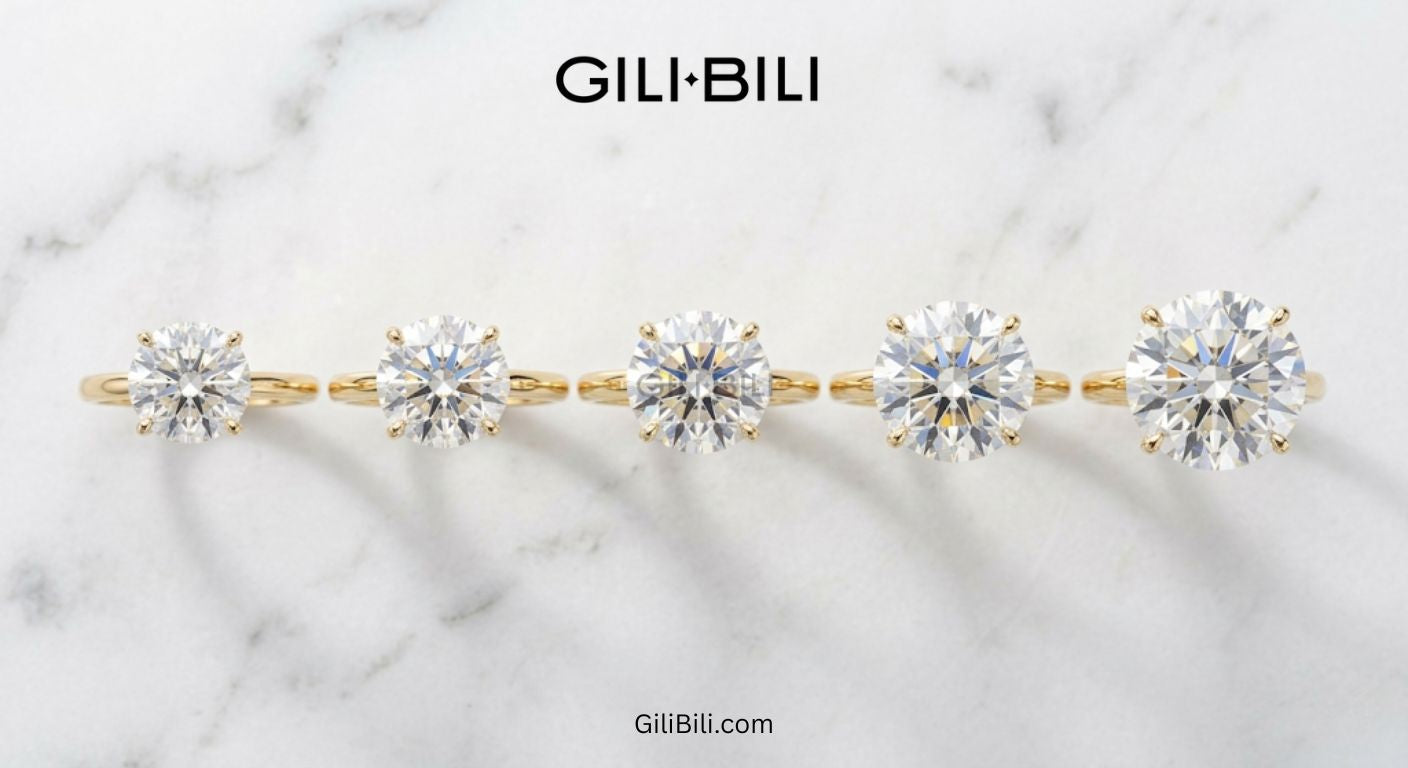
Understanding lab-grown diamond price per carat is one of the first things smart buyers research and one of the most confusing, because price per carat is not a fixed number. It changes dramatically depending on carat weight, quality specifications, shape, and where you buy. This guide cuts through all of that.
I’m Chintan Dhola, Co-Founder and Chief Jewelry Expert at GiliBili.com. With over 12 years in diamond manufacturing, sourcing, and grading, I work with lab-grown diamonds at every price point every day. In this guide I am going to give you the most clear and honest price breakdown available for lab-grown diamonds from 2 carats to 5 carats in both USD and GBP along with exactly what drives those prices and how to get the best value at every size.
At GiliBili, a complete IGI-certified lab-grown diamond ring in D–F color, VS–VVS clarity, Excellent cut, set in 14K or 18K gold starts at $2,000 for 1.5 carats and goes to $8,000 to $9,000 for 5 carats. The full breakdown is in the table below. Let’s start with understanding why price per carat rises so sharply as size increases.

Why Lab-Grown Diamond Price Per Carat Increases With Size
Most buyers assume that lab-grown diamond price per carat is relatively consistent that a 3 carat diamond costs roughly three times a 1 carat diamond of the same quality. This is not how diamond pricing works. Price per carat rises exponentially as size increases, and the reasons are rooted in the physics of lab diamond production.
Lab-grown diamonds are created in controlled growth chambers using either HPHT (High Pressure High Temperature) or CVD (Chemical Vapour Deposition) technology. Growing larger crystals requires significantly more time in the chamber, more precise environmental control, and a much higher percentage of the resulting rough crystals disqualifying due to defects at larger sizes.
To produce a gem-quality 1 carat lab-grown diamond might require 10 to 14 days of growth. A 3 carat crystal requires 30 to 45 days. A 5 carat crystal may take 60 days or more. Each day in the growth chamber carries energy costs, equipment costs, and risk. The longer the growth, the more chances for an event that disqualifies the crystal for gem use. This is why price per carat accelerates at each carat milestone.
The result is a pricing structure where the jump from 2 carats to 3 carats costs more per carat than the jump from 1 carat to 2 carats. And the jump from 4 to 5 carats costs significantly more per carat than any previous step. Understanding this helps you make smarter decisions about where to position your budget for maximum visual impact.
Complete Lab-Grown Diamond Price Per Carat: 1ct to 10ct Reference Table
Here is the complete price reference for IGI-certified lab-grown diamond rings at GiliBili D–F color, VS–VVS clarity, Excellent cut, set in 14K or 18K gold. This is the full spectrum from 1 carat to 10 carats so you can see the price-per-carat acceleration pattern clearly:
|
Carat Weight |
Ring Price (USD) |
Ring Price (GBP) |
Diamond Price Per Carat 2026 |
Natural Diamond Equivalent (USD) |
|
1.0 ct |
$1,500 – $2,000 |
£1,230 – £1,640 |
~$500 |
$8,000 – $15,000 |
|
1.5 ct |
$2,000 – $2,500 |
£1,640 – £2,050 |
~$575 |
$12,000 – $22,000 |
|
2.0 ct |
$2,500 – $3,000 |
£2,050 – £2,460 |
~$700 |
$20,000 – $40,000 |
|
3.0 ct |
$4,500 – $5,000 |
£3,690 – £4,100 |
~$900 |
$40,000 – $80,000 |
|
3.5 ct |
$5,000 – $5,500 |
£4,100 – £4,510 |
~$1100 |
$60,000 – $100,000 |
|
4.0 ct |
$6,000 – $6,500 |
£4,920 – £5,330 |
~$1,250 |
$80,000 – $150,000 |
|
5.0 ct |
$8,000 – $9,000 |
£6,560 – £7,380 |
~$1,500 |
$200,000 – $500,000 |
|
6.0 ct |
$9,000 – $10,000 |
£7,380 – £8,200 |
~$1,500 |
$350,000+ |
|
7.0 ct |
$10,000 – $11,000 |
£8,200 – £9,020 |
~$1,500 |
$500,000+ |
|
10.0 ct |
$15,000 – $17,000 |
£12,300 – £13,940 |
~$1550 |
$1,000,000+ |
A few important observations from this table. First, price per carat for lab-grown diamonds remains broadly in the $500 to $1,500 range from 1 carat to 10 carats. This is one of the most remarkable things about lab-grown technology the per-carat cost does not spiral upward the way it does for natural diamonds, where a 5 carat stone costs 50 to 100 times more per carat than a 1 carat stone of equivalent quality.
Second, the total ring price acceleration still follows the exponential pattern from 2 carats onward from $2,500 at 2 carats to $8,000 to $9,000 at 5 carats. This is because total price is price-per-carat multiplied by carat weight, and as both factors increase together the total rises steeply. But compare those total prices to the natural diamond equivalent column and the contrast remains extraordinary at every size.
2 Carat Diamond Ring Price: What You Get at This Size
A 2 carat diamond ring at GiliBili is priced at $2,500 to $3,000 (£2,050 to £2,460) in D–F color, VS–VVS clarity, Excellent cut, IGI-certified, set in 14K or 18K gold. This size delivers a diamond that measures approximately 8.1 mm across in round brilliant a genuinely impressive size that reads as clearly luxurious in person.
At 2 carats, you are crossing what many buyers consider the psychological threshold from a beautiful ring into an unmistakably statement ring. The diamond is large enough to be the first thing people notice about your hand. It photographs beautifully. And at $2,500 to $3,000 in lab-grown, it is accessible to buyers who would have been looking at much smaller natural diamonds in the same budget.
2 Carat: Shape and Price Variations
The $2,500 to $3,000 price range for a 2 carat lab-grown ring at GiliBili covers the most popular shapes at standard proportions. Elongated shapes like oval and pear at ideal length-to-width ratios may sit at the upper end of this range. Round brilliants tend to be mid-range. Cushion and radiant shapes are also available within this range.
|
|
2ct Lab-Grown (GiliBili) |
2ct Natural Diamond (est.) |
Visual Size (Round) |
|
Price range |
$2,500 – $3,000 |
$20,000 – $40,000 |
~8.1 mm diameter |
|
Color |
D – F |
D – F |
Colorless |
|
Clarity |
VS1 – VVS2 |
VS1 – VVS2 |
Visually flawless |
|
Cut |
Excellent |
Excellent |
Maximum brilliance |
|
Cert. |
IGI + laser inscription |
GIA or IGI |
— |
|
Setting |
14K or 18K gold |
Platinum or 18K gold |
— |
3 Carat Diamond Ring Price: The Most Popular Premium Size
A 3 carat lab-grown diamond ring at GiliBili is priced at $4,500 to $5,000 (£3,690 to £4,100). This is our most popular premium size and represents one of the most compelling value propositions in fine jewelry anywhere. A 3 carat round brilliant measures 9.2 to 9.4 mm across a clearly spectacular stone that makes an unmistakable impression.
The price jump from 2 carats ($2,500 to $3,000) to 3 carats ($4,500 to $5,000) is significant approximately $2,000. This reflects the longer crystal growth time and higher production complexity at 3 carats. But compare the 3 carat lab-grown price of $4,500 to $5,000 to the natural diamond equivalent of $40,000 to $80,000, and the value at this size is transformative.
The 3 carat size is where most buyers who are genuinely serious about the visual impact of their ring land. It is large enough to be spectacular. It is proportioned beautifully on most finger sizes. And in lab-grown, it is within reach of buyers who would otherwise have been looking at 1 to 1.5 carat natural diamonds at the same budget.

4 Carat Diamond Ring Price: Entering the Luxury Tier
A 4 carat lab-grown diamond ring at GiliBili is priced at $6,000 to $6,500 (£4,920 to £5,330). At this size you are firmly in luxury ring territory. A 4 carat round brilliant measures approximately 10.2 mm across, covering over 60 percent of an average finger width. The visual impression is extraordinary.
The price step from 3 carats to 4 carats is approximately $1,500 to $1,500. This is a more modest per-step increase than the 2-to-3 carat jump reflecting the relatively more linear growth in production complexity in this range. For buyers who want to push into clearly spectacular territory without the full 5 carat premium, 4 carats at $6,000 to $6,500 is an exceptional sweet spot.
In elongated shapes at 4 carats, the visual impact is extraordinary. A 4 carat oval measures approximately 13 x 10 mm nearly the full length of a fingernail. A 4 carat pear at around 16 x 10 mm is truly finger-spanning. At this size, shape choice is about personality and visual preference rather than impact because every shape at 4 carats is impressive.
5 Carat Lab Diamond Cost: The Ultimate Statement
A 5 carat lab diamond ring at GiliBili costs $8,000 to $9,000 (£6,560 to £7,380). This is the point where lab-grown technology creates its most dramatic value proposition: the equivalent natural diamond quality would cost $200,000 to $500,000. At $8,000 to $9,000, the 5 carat lab-grown represents access to a tier of jewelry that was previously available only to the ultra-wealthy.
A 5 carat round brilliant measures approximately 11 mm across, covering roughly 70 percent of an average finger width. In elongated shapes the effect is even more spectacular: a 5 carat oval at approximately 15 x 11 mm runs nearly the full length of the fingernail. A 5 carat pear at 18 x 11 mm is simply extraordinary.
At $8,000 to $9,000, buyers get the identical physical, chemical, and optical properties to a natural stone of the same quality. The same IGI certification. The same laser inscription. The same D-to-F colorless brilliance. The same VS-to-VVS visual clarity. The cost difference reflects geological time and mining infrastructure not any difference you can see or feel in the finished ring.
|
Size |
Round Diameter |
USD Price |
GBP Price |
Natural Equiv. (USD) |
Visual Character |
|
2.0 ct |
~8.1 mm |
$2,500 – $3,000 |
£2,050 – £2,460 |
$20,000 – $40,000 |
Clearly luxurious, statement ring |
|
2.5 ct |
~8.8 mm |
$3,500 – $4,000 |
£2,870 – £3,280 |
$30,000 – $60,000 |
Bold, glamorous, impressive |
|
3.0 ct |
~9.2 mm |
$4,500 – $5,000 |
£3,690 – £4,100 |
$40,000 – $80,000 |
Spectacular, unmistakable |
|
3.5 ct |
~9.7 mm |
$5,000 – $5,500 |
£4,100 – £4,510 |
$60,000 – $100,000 |
Commanding, dramatic |
|
4.0 ct |
~10.2 mm |
$6,000 – $6,500 |
£4,920 – £5,330 |
$80,000 – $150,000 |
Show-stopping luxury |
|
4.5 ct |
~10.6 mm |
$7,000 – $7,500 |
£5,740 – £6,150 |
$120,000 – $200,000 |
Extraordinary, extraordinary presence |
|
5.0 ct |
~11.0 mm |
$8,000 – $9,000 |
£6,560 – £7,380 |
$200,000 – $500,000 |
Ultimate statement, room-crossing presence |
What Affects Lab-Grown Diamond Price Per Carat Beyond Size?
Carat weight is the biggest driver of price, but it is not the only one. Here are the other factors that move lab-grown diamond price per carat within any given size tier:
Color Grade
D color commands a premium over F color at every carat weight. The visual difference between D and F is imperceptible to the naked eye, but D carries a prestige premium. At GiliBili we work across the D–F range. For buyers focused on maximum value without visual compromise, E or F color at any carat weight delivers visually identical results to D at a slightly lower price.
Clarity Grade
VVS1 clarity carries a premium over VS1. For brilliant-cut shapes, both are visually flawless the difference is only visible under magnification. For most buyers, VS1 is the value-optimised choice for brilliant cuts. For step-cut shapes (emerald, asscher), VVS2 is the recommended minimum and VVS1 is worth the premium.
Shape and Length-to-Width Ratio
Within the same carat weight, different shapes carry different price points. Round brilliants tend to command slightly higher prices than fancy shapes because of the greater rough diamond waste in cutting a round. Within fancy shapes, elongated cuts at ideal length-to-width ratios (1.45–1.55 for oval, 1.50–1.65 for pear) also carry modest premiums over average proportions.
Setting Metal
The setting cost is a meaningful component of total ring price at every carat weight. A 14K gold solitaire setting adds $400 to $700 to the diamond cost. An 18K gold setting with pavé band adds $700 to $1,200. A platinum setting for a larger stone adds $1,000 to $1,500. At GiliBili our published ring prices include setting so the prices in this guide represent complete, wearable rings.
Certification
Every GiliBili solitaire diamond is IGI-certified with laser inscription. The cost of IGI certification is built into our prices. Some sellers offer lower prices by selling uncertified or poorly certified stones this is a false saving. An uncertified diamond has unknown quality, unknown identity, and negligible resale value. Never buy a significant diamond without current IGI or GIA certification.
|
Factor |
Lower Price |
Higher Price |
Visual Impact at 3–5ct |
|
Color |
F color |
D color |
None — visually identical to naked eye |
|
Clarity |
VS1 |
VVS1 |
None for brilliant cuts — both eye-clean |
|
Shape |
Fancy shapes (oval/pear) |
Round brilliant |
Round has most symmetrical brilliance |
|
L/W Ratio |
Average proportion |
Ideal ratio |
Better proportioned stones look more elegant |
|
Setting metal |
14K gold |
Platinum |
Platinum preferred for 4ct+ for durability |
|
Certification |
Uncertified |
IGI with laser inscription |
No visual impact , but critical for trust |
|
Fluorescence |
Faint (slight discount) |
None |
Strong fluorescence can haze large stones |

How to Get the Best Value on Lab-Grown Diamond Price Per Carat
Knowing the prices is only half the equation. Here is how to make sure you are getting genuine value at any size in the 2 to 5 carat range:
• Prioritise cut over clarity every time. An Excellent cut VS1 diamond will outperform a Very Good cut VVS1 in every lighting condition. Cut is how the diamond performs. Clarity is just about what you can see under magnification. Never sacrifice cut grade to save on price.
• Choose E or F color instead of D for brilliant cuts. There is no visible difference between D, E, and F color to the naked eye in any brilliant-cut shape. Choosing F color over D at 3 carats can save you $200 to $400 with zero visual compromise.
• Consider a half-carat step up for disproportionate visual gain. The visual difference between 2.5 and 3 carats is significant. The visual difference between 3 and 3.5 carats is modest. If your budget allows a stretch, 2.5 to 3 carats is the most impactful size jump in the 2 to 5 carat range.
• Always insist on IGI certification and laser inscription. Uncertified lab-grown diamonds have no verifiable quality identity. Some sellers discount by offering uncertified stones or using minor labs with inconsistent grading. IGI and GIA are the only certifications that hold their value as a quality guarantee.
• Choose the setting metal appropriate to the carat weight. For 2 and 3 carat rings, 14K and 18K gold in any colour are excellent choices. At 4 and 5 carats, platinum becomes worth considering for its superior prong durability on a more valuable stone.
• Buy the diamond and setting together from one trusted source. The setting must be engineered for the specific diamond dimensions particularly at 3 carats and above. At GiliBili, we design every setting around the specific stone, which ensures correct prong placement, ideal basket height, and a result that looks as good in person as it does in the CAD render.
Custom Lab Diamond Rings at GiliBili: 2ct to 5ct
Every ring at GiliBili in the 2 to 5 carat range is custom-made to your specifications. We do not offer off-the-shelf settings for stones at these sizes. Here is the process:
• You specify carat weight, shape, and preferred L/W ratio for elongated shapes
• We source your IGI-certified lab-grown diamond in D–F color, VS–VVS clarity, Excellent cut, None fluorescence
• We provide full video of the actual stone before any setting work begins
• Our design team creates a CAD rendering of your chosen setting sized to your ring size and the specific stone dimensions
• Handcrafted in solid 14K or 18K gold or platinum by our senior craftsmen
• Free worldwide fully insured shipping and 30-day return policy
Start on our engagement ring collection, browse our best-selling styles, or start a fully custom design. Also explore our full lab-grown diamonds page for more information on quality and certification.
Real Buyer FAQs: Lab-Grown Diamond Price Per Carat
How much does a lab-grown diamond cost per carat?
Lab-grown diamond price per carat at GiliBili in D–F color, VS–VVS clarity, Excellent cut, IGI-certified ranges from approximately $575 per carat at 2 carats to $1,500 per carat at 5 carats. Total ring prices run from $2,500 to $3,000 for a 2 carat ring to $8,000 to $9,000 for a 5 carat ring, including the 14K or 18K gold setting.
Why does lab-grown diamond price per carat increase with size?
Larger lab-grown diamonds require significantly more time in the growth chamber a 5 carat crystal may take 60 or more days to grow compared to 10 to 14 days for a 1 carat crystal. Longer growth means more energy, more equipment time, and a higher percentage of crystals that fail quality checks. This is why price per carat rises as size increases, even for lab-grown diamonds.
What is the price of a 2 carat lab diamond ring?
A 2 carat lab-grown diamond ring at GiliBili in D–F color, VS–VVS clarity, Excellent cut, IGI-certified, set in 14K or 18K gold, costs $2,500 to $3,000 (approximately £2,050 to £2,460). An equivalent natural 2 carat diamond ring typically costs $20,000 to $40,000, making the lab-grown option 85 to 92 percent less expensive for identical visual and certified quality.
What does a 5 carat lab-grown diamond ring cost?
A 5 carat lab-grown diamond ring at GiliBili D–F color, VS–VVS clarity, Excellent cut, IGI-certified, in 14K or 18K gold costs $8,000 to $9,000 (£6,560 to £7,380). The natural diamond equivalent at this quality level costs $200,000 to $500,000 or more. Lab-grown technology makes the 5 carat size accessible to a vastly wider group of buyers than was ever possible before.
Is there a price difference between lab-grown diamond shapes?
Yes, modest differences exist. Round brilliants typically command a slight premium over fancy shapes because of greater rough diamond waste in cutting. Within fancy shapes, elongated cuts at ideal length-to-width ratios (oval 1.45–1.55, pear 1.50–1.65) carry a small premium over average proportions. These differences are modest compared to the price impact of carat weight and quality grade.
Do lab-grown diamond prices change over time?
Yes. Lab-grown diamond production costs have decreased significantly over the past five years as technology has improved and supply has increased. Prices in the primary market have fallen considerably since 2020. This is one reason why lab-grown diamonds currently offer extraordinary value. It also means that the resale market for lab-grown diamonds reflects declining production costs, which buyers should factor in to their expectations.
Conclusion: Lab-Grown Diamond Price Per Carat in 2026
The lab-grown diamond price per carat in 2026 represents the most compelling value in fine jewelry available anywhere. From $2,500 to $3,000 for a stunning 2 carat ring to $8,000 to $9,000 for a spectacular 5 carat lab diamond, buyers can access sizes and quality levels that were previously out of reach for most people all with identical physical properties, the same IGI certification, and the same fire and brilliance as natural diamonds costing ten to one hundred times more.
Whether you are looking at a 2 carat diamond ring price or planning a 5 carat statement piece, GiliBili builds every ring to the highest quality standard at every size. D–F color. VS–VVS clarity. Excellent cut. IGI-certified. Every time.
Connect with us on WhatsApp: +91 8200212331 (instant reply)
Email: hello@gilibili.com
We help with loose lab diamonds, custom jewelry, engagement rings, and fancy color lab diamonds. Tell us your carat target and we will find the perfect stone.


Recent Post


