Cart
0
Checking your FREE GIFT offer...


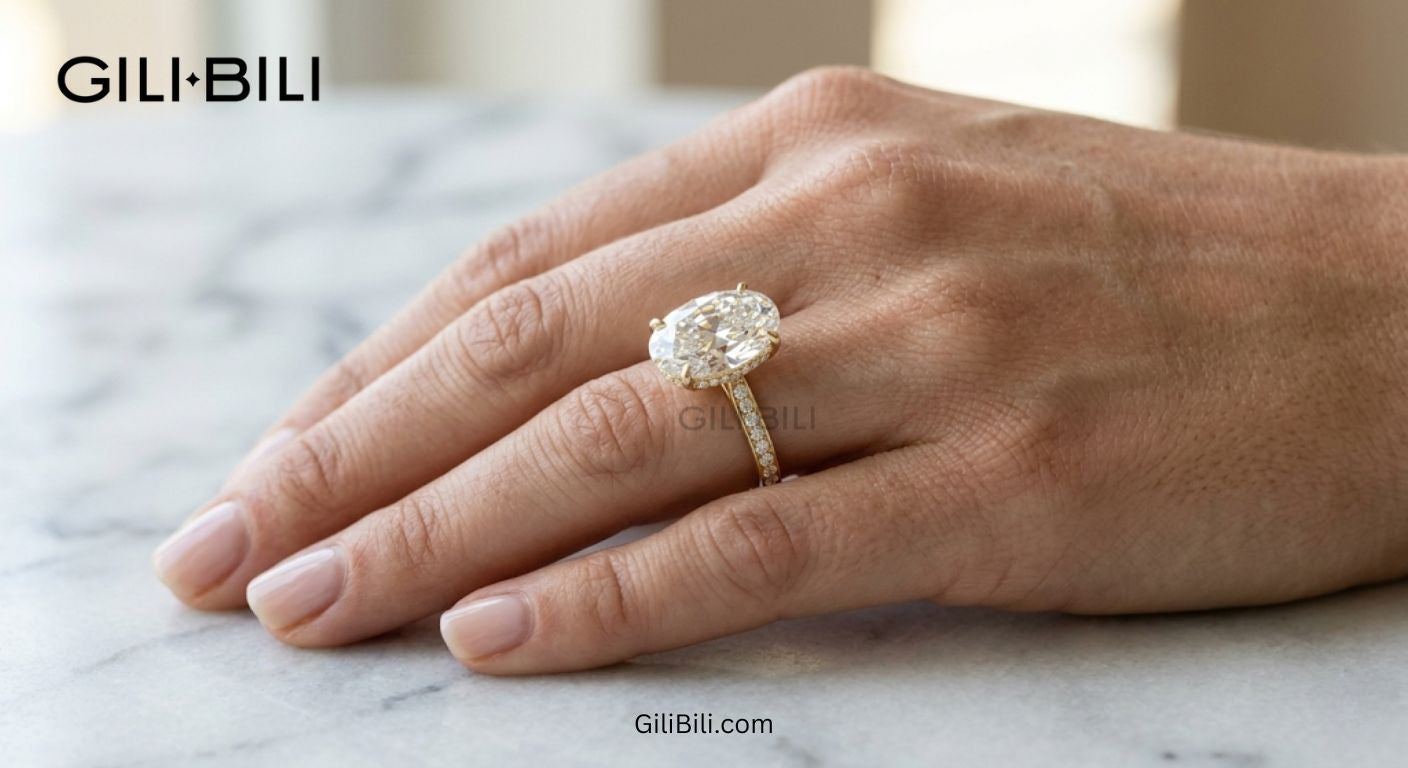
There is a point where a diamond stops being impressive and starts being spectacular. The 5 carat lab diamond ring sits firmly in that category. At this size, you are not just wearing a beautiful piece of jewelry you are making an unmistakable statement. And in 2026, the 5 carat diamond ring price in lab-grown has brought this once-exclusive size within reach of a much wider group of buyers than ever before.
I’m Chintan Dhola, Co-Founder and Chief Jewelry Expert at GiliBili.com. With over 12 years in diamond manufacturing, grading, and fine jewelry production, I have worked with 5 carat stones across every shape and setting imaginable. In this guide, I will walk you through exactly what a 5 carat lab-grown diamond ring costs, what drives the price at this size, how different shapes compare, and what to look for to ensure you are getting the highest possible quality.
A premium IGI-certified 5 carat lab-grown diamond ring at GiliBili starts from $8,000 to $9,000 (£6,560 to £7,380) in D-F color, VS-VVS clarity, and Excellent cut, set in solid 14K or 18K gold. A natural diamond of equivalent quality at 5 carats would cost $200,000 to $500,000 or more.

A premium 5 carat lab-grown diamond ring IGI-certified, D-F color, VS-VVS clarity, Excellent cut, set in 14K or 18K gold costs between $8,000 and $9,000 at GiliBili. The exact price within this range depends on the diamond shape, length-to-width ratio, the specific clarity grade (VS1 vs VVS2), and the setting style you choose.
That number needs context. A natural 5 carat diamond with comparable quality D-F color, VS-VVS clarity, Excellent cut is extraordinarily rare in nature and carries a price tag of $200,000 to $500,000 or significantly more at auction. Even a natural 5 carat diamond of lower quality (G-H color, SI clarity) would typically cost $80,000 to $150,000.
Lab-grown diamonds at 5 carats are where the value proposition of this technology becomes most dramatic. You are getting identical physical, chemical, and optical properties to a natural stone. The same IGI certification. The same laser inscription. The same fire, brilliance, and visual size. At a fraction of the cost. This is not a compromise it is a fundamentally different way of accessing the luxury diamond market.
To fully understand the 5 carat diamond ring price, it helps to see it in context with the carat weights around it. Here is the complete luxury segment price guide for lab-grown diamond rings at GiliBili, all at D-F color, VS-VVS clarity, Excellent cut:
| Carat Weight | Round Diameter | Price (USD) | Price (GBP) | Natural Diamond Equivalent |
|---|---|---|---|---|
| 3.0 ct | ~9.2 mm | $4,500 – $5,000 | £3,690 – £4,100 | $40,000 – $80,000+ |
| 3.5 ct | ~9.7 mm | $5,000 – $5,500 | £4,100 – £4,510 | $60,000 – $100,000+ |
| 4.0 ct | ~10.2 mm | $6,000 – $6,500 | £4,920 – £5,330 | $80,000 – $150,000+ |
| 5.0 ct | ~11.0 mm | $8,000 – $9,000 | £6,560 – £7,380 | $200,000 – $500,000+ |
| 6.0 ct | ~11.7 mm | $9,000 – $10,000 | £7,380 – £8,200 | $350,000 – $800,000+ |
| 7.0 ct | ~12.4 mm | $10,000 – $11,000 | £8,200 – £9,020 | $500,000 – $1,000,000+ |
Look at the price acceleration pattern. Moving from 3 to 4 carats increases the lab-grown price by roughly $1,500. Moving from 4 to 5 carats increases it by roughly $2,000 to $2,500. This is because larger rough lab-grown diamond crystals require longer growth times and more controlled conditions, which increases production cost. But compare these increments to the natural diamond equivalent column and the contrast is staggering.
The 5 carat is particularly compelling in this table because it represents the point where natural diamonds become genuinely inaccessible to most buyers. In lab-grown, it is a meaningful but achievable luxury. In natural, it is a stratospheric investment piece.
A 5 carat round brilliant diamond measures approximately 11.0 mm in diameter. On an average ring finger (US size 6 to 7, approximately 15 to 16 mm wide), this diamond covers roughly 70 percent of the finger’s full width. The visual impact is extraordinary. This is a stone that draws attention across a room, not just up close.
In elongated shapes like oval and pear, a 5 carat stone is even more spectacular. A 5 carat oval measures approximately 15 x 11 mm nearly the full length of an average fingernail. A 5 carat pear measures around 18 x 11 mm. At these dimensions, the diamond doesn’t just sit on the finger it defines the entire hand.
| Shape | 5ct Dimensions (mm) | Visual Scale on Finger | Most Flattering For |
|---|---|---|---|
| Round Brilliant | ~11.0 × 11.0 | Covers ~70% of avg. finger width | All finger types, maximum brilliance |
| Oval | ~15.0 × 11.0 | Near full length of fingernail | All fingers, especially shorter |
| Pear | ~18.0 × 11.0 | Finger-spanning dramatic length | Slender fingers, maximum elongation |
| Emerald Cut | ~14.0 × 10.0 | Large architectural open face | All fingers, quiet luxury aesthetic |
| Cushion | ~11.3 × 11.3 | Full, soft coverage of finger | All fingers, romantic softness |
| Marquise | ~20.0 × 10.0 | Extraordinary length across hand | Slender fingers, show-stopping look |
| Radiant | ~11.5 × 10.5 | Bold, brilliant modern look | All fingers, mixed step/brilliant cut |
The most important thing to understand about a 5 carat diamond on the finger is that no shape at this weight looks small. The choice between shapes at 5 carats is not about size it is about personality. Round for maximum brilliance. Oval or pear for maximum elongation. Emerald for architectural elegance. Cushion for romantic softness.

Understanding what drives 5 carat lab diamond ring cost helps you make smarter decisions about where to allocate your budget within the luxury segment. Here are the factors that have the most significant effect on price at this size:
1. Carat Weight and Crystal Growth Time
Growing a 5 carat rough lab-grown diamond crystal requires significantly more time in the growth chamber than a 3 carat crystal often 30 to 50 percent longer, depending on the growth method (HPHT or CVD). Longer growth time means higher energy costs, higher equipment usage costs, and greater risk of growth defects that would disqualify the crystal for gem-quality use. This is why price per carat increases at each carat milestone.
2. Color Grade-D to F at 5 Carats
Color is significantly more visible in a 5 carat stone than in a 1 or 2 carat stone. The larger face and greater depth of the diamond mean that any yellow or warm tint becomes noticeable face-up, particularly in certain lighting conditions. At GiliBili we only offer D-F colorless grades for 5 carat stones. This is not optional at this size anything below F color will be visible in a stone this large and will affect the long-term desirability of the ring.
3. Clarity Grade-Why VS or Better Is Non-Negotiable at 5 Carats
A 5 carat diamond has a much larger visible surface area than a 1 or 2 carat stone. Inclusions that would be invisible at smaller sizes can be clearly visible to the naked eye at 5 carats, particularly in step-cut shapes like emerald and asscher where the open faceting acts almost like a magnifying glass. VS1 clarity is our absolute minimum recommendation at 5 carats. VVS2 and above provides complete peace of mind that the stone will be visually flawless in everyday viewing.
4. Cut Grade-Everything at 5 Carats Comes Down to Cut
An Excellent cut 5 carat diamond is transformative. The larger facets catch and scatter light across a wider area than any smaller stone, producing fire and brilliance that is genuinely breathtaking. A poorly cut 5 carat diamond of the same carat weight will look dull and lifeless by comparison. At this price point, never settle for anything below Excellent cut. The cut is what separates a spectacular stone from an expensive disappointment.
5. Shape and Length-to-Width Ratio
At 5 carats, different shapes are priced similarly for the diamond itself, but the complexity of cutting certain shapes particularly well-proportioned pear and marquise cuts can add to the cost. Elongated shapes require more careful cutting to achieve proper symmetry and minimise bow-tie effects. A perfectly cut 5 carat oval with negligible bow-tie and excellent wing symmetry commands a premium over an average example at the same carat weight.
6. Setting Material and Craftsmanship
At 5 carats, the setting needs to be engineered specifically for the weight and dimensions of the stone. Prongs must be thicker and more precisely positioned than for a 3 carat stone. Platinum is often recommended at this size for its density and long-term prong integrity. Custom settings with pavé shoulders, hidden halos, or bespoke band designs add meaningful cost but are entirely worth it for a stone of this calibre. At GiliBili, every 5 carat setting is hand-engineered to the specific diamond dimensions.
The gap between lab-grown and natural diamond pricing is at its most dramatic in the 5 carat segment. This is where the technology of lab-grown diamonds creates its most extraordinary value proposition.
| Quality | 5ct Lab-Grown (GiliBili) | 5ct Natural Diamond (est.) | Difference |
|---|---|---|---|
| D color, VVS2, Excellent | $8,500 – $9,000 | $300,000 – $500,000+ | ~97–98% less |
| E color, VS1, Excellent | $8,000 – $8,500 | $200,000 – $350,000+ | ~96–97% less |
| F color, VS2, Excellent | $8,000 – $8,500 | $150,000 – $250,000+ | ~95–97% less |
Both natural and lab-grown 5 carat diamonds are certified to identical IGI standards. Both carry laser inscriptions. Both have the same physical, chemical, and optical properties. The price difference reflects the cost of geological time and mining infrastructure not the quality or beauty of the stone in your ring.
At 5 carats, choosing lab-grown does not mean choosing a lesser diamond. It means choosing the same diamond without paying for rarity that is invisible in the stone itself. The light performance, the sparkle, the color, the clarity all identical. The only thing that changes is the number on the price tag.
Learn more about lab-grown diamond quality and certifications on our lab-grown diamonds page.
At 5 carats, the setting serves two purposes: it must provide exceptional security for a significant stone, and it must present that stone in a way that honours its scale and quality. Here are the settings that work best at this carat weight:
Six-Prong Solitaire-Security and Elegance
For a 5 carat round brilliant, a six-prong solitaire in platinum or 18K gold is the gold standard. Six prongs provide maximum security for a stone of this value and weight, while still allowing excellent light entry from the sides. The prongs at 5 carats should be slightly thicker than at 3 carats this is something we engineer specifically at GiliBili for every large-carat setting.
Low-Profile Cathedral Solitaire-Daily Wearability at 5 Carats
A 5 carat diamond in a traditional high cathedral setting can sit 8 to 10 mm above the band, making it uncomfortable for daily wear and prone to catching on clothing. A low-profile cathedral setting reduces this height significantly while maintaining the elegant curved approach to the basket. If you plan to wear your 5 carat ring every day, the low-profile cathedral is my first recommendation.
Platinum Solitaire-The Premium Choice at This Size
Platinum is my recommended metal for 5 carat diamond rings. Its density (significantly heavier than gold) provides superior long-term stability for the prongs holding a stone of this value. It will never require replating, develops a distinguished patina over time, and provides a naturally white setting that complements a D-F colorless diamond perfectly. At $8,000 to $9,000 for the stone, the modest premium for platinum over 18K white gold is entirely justified.
Hidden Halo Maximising Visual Impact Without Clutter
A micro-pave hidden halo beneath the girdle of a 5 carat diamond adds sparkle from the sides and perceived visual size without competing with the center stone from above. At 5 carats, the hidden halo is subtle the small diamonds in the halo are dwarfed by the scale of the center stone. But they add a quality detail that elevates the ring from impressive to extraordinary.
East-West Settings for Elongated Shapes
A 5 carat oval or pear set east-west (horizontally across the finger) creates one of the most dramatic engagement ring looks available anywhere. The 15 mm length of a 5 carat oval running across the full width of the finger is a show-stopping statement that photographs magnificently. If drama and individuality are what you are after at 5 carats, this is the configuration to explore.

Buying at 5 carats is a different experience from buying at 2 or 3 carats. The stakes are higher, the quality details matter more, and the differences between stones that look similar on a certificate can be enormous in person. Here is what I tell every buyer at this size:
• Always insist on VVS clarity or VS1 minimum. At 5 carats, VS2 inclusions that would be invisible in a 2 carat stone can be visible to the naked eye, particularly in step-cut shapes. Do not risk it. VVS2 or VS1 gives you complete confidence that the stone is visually flawless.
• Never compromise on cut grade at this size. An Excellent cut 5 carat diamond is genuinely breathtaking. A Very Good or Good cut at the same carat weight will look noticeably less brilliant and less alive. The cut premium at 5 carats is absolutely worth paying.
• Request a video of the specific stone in multiple lighting conditions. A certificate tells you what the stone is. A video tells you how it actually looks. At 5 carats, always watch the stone rotate in natural light, diffused light, and dark-field lighting before committing. At GiliBili we video every stone we propose at this size.
• Check for bow-tie in elongated shapes. Oval, pear, and marquise diamonds all have some degree of bow-tie shadow across the centre. At 5 carats, the bow-tie is more visible than at smaller sizes. A premium cut will have a negligible bow-tie. This can only be assessed on video or in person not from a certificate.
• Choose the setting metal based on longevity, not just aesthetics. Platinum is the strongest recommendation at 5 carats for its prong durability and long-term colour stability. If yellow gold is essential to the aesthetic you want, 18K is perfectly strong enough, but have the prongs checked annually by a jeweller.
• Insure it immediately upon delivery. A 5 carat lab-grown diamond ring worth $8,000 to $9,000 should be insured before it is worn. Your IGI certificate is the insurance document. At GiliBili, every ring ships fully insured, but buyer’s personal jewelry insurance should be arranged the same day the ring is received.
Every 5 carat ring we build at GiliBili is a bespoke commission. We do not sell off-the-shelf at this size because a stone of this calibre deserves a setting that is engineered specifically for it. Here is how the process works:
• We source your IGI-certified 5 carat lab-grown diamond directly you specify the shape, precise L/W ratio (for elongated shapes), color (D-F), and clarity (VS1-VVS2)
• We provide a detailed video of the actual stone before any setting work begins so you can assess bow-tie, brilliance, and overall character
• Our design team creates a full CAD rendering of your chosen setting with precise prong engineering for the specific stone dimensions
• Every ring is handcrafted in solid 18K gold (yellow, white, or rose) or platinum by our senior craftsmen
• Free worldwide fully insured shipping and 30-day return policy
Start your design on our custom jewelry page or browse our engagement ring collection for setting inspiration.
How much does a 5 carat lab-grown diamond ring cost?
At GiliBili, a premium IGI-certified 5 carat lab-grown diamond ring in D-F color, VS-VVS clarity, and Excellent cut, set in 14K or 18K gold, costs between $8,000 and $9,000 (£6,560 to £7,380). An equivalent natural diamond at this quality level would cost $200,000 to $500,000 or significantly more.
Is a 5 carat lab-grown diamond the same quality as a 5 carat natural diamond?
Yes, entirely. Lab-grown and natural diamonds are physically, chemically, and optically identical. A 5 carat lab-grown diamond is a real diamond graded to the same IGI standards as a natural stone of the same size. The only difference is origin. At GiliBili, every 5 carat diamond carries full IGI certification with laser inscription.
What clarity should I choose for a 5 carat diamond ring?
At 5 carats, the large visible surface makes clarity selection critical. We recommend VS1 as the absolute minimum for a 5 carat diamond, with VVS2 being the preferred grade for complete visual confidence. In step-cut shapes like emerald cut, VVS1 or VVS2 is strongly recommended because the open faceting makes inclusions significantly more visible than in brilliant-cut shapes.
How big is a 5 carat diamond on the finger?
A 5 carat round diamond measures approximately 11.0 mm in diameter covering roughly 70 percent of an average finger’s width. In elongated shapes it is even more dramatic: a 5 carat oval measures approximately 15 x 11 mm, and a 5 carat pear approximately 18 x 11 mm. At any size finger, a 5 carat diamond is a commanding, unmistakable presence.
What is the best shape for a 5 carat lab diamond ring?
There is no single best shape it depends entirely on the aesthetic you want. For maximum brilliance, round brilliant. For maximum visual size and finger elongation, oval or pear. For quiet luxury and architectural elegance, emerald cut. For romantic softness, cushion. At 5 carats, every shape is spectacular the choice comes down to personal style.
Should I choose platinum or gold for a 5 carat diamond ring?
Platinum is the preferred choice for 5 carat diamond rings due to its superior density and long-term prong durability. It will never require replating and its natural white colour complements a D-F diamond perfectly. 18K yellow gold is an excellent alternative if the warm aesthetic is important to you. 18K rose gold creates a beautiful, romantic contrast with a colorless stone at this size.
The answer is yes emphatically. The 5 carat lab diamond ring cost of $8,000 to $9,000 at GiliBili represents extraordinary value for a stone that would cost $200,000 to $500,000 in natural diamond quality. The visual impact of a 5 carat diamond on the finger is spectacular at any shape. The quality D-F color, VS-VVS clarity, Excellent cut, IGI-certified is the absolute highest available.
In 2026, the 5 carat 5 carat diamond ring price in lab-grown has moved this size from the exclusive domain of the ultra-wealthy into reach for buyers who want genuine luxury without the natural diamond premium. If you are ready to own something truly exceptional, we are here to help you build it.
Connect with us on WhatsApp: +91 8200212331 (instant reply)
Email: hello@gilibili.com
We help with loose lab diamonds, custom jewelry, engagement rings, and fancy color lab diamonds. Your 5 carat dream ring is one conversation away.


