Cart
0
Checking your FREE GIFT offer...


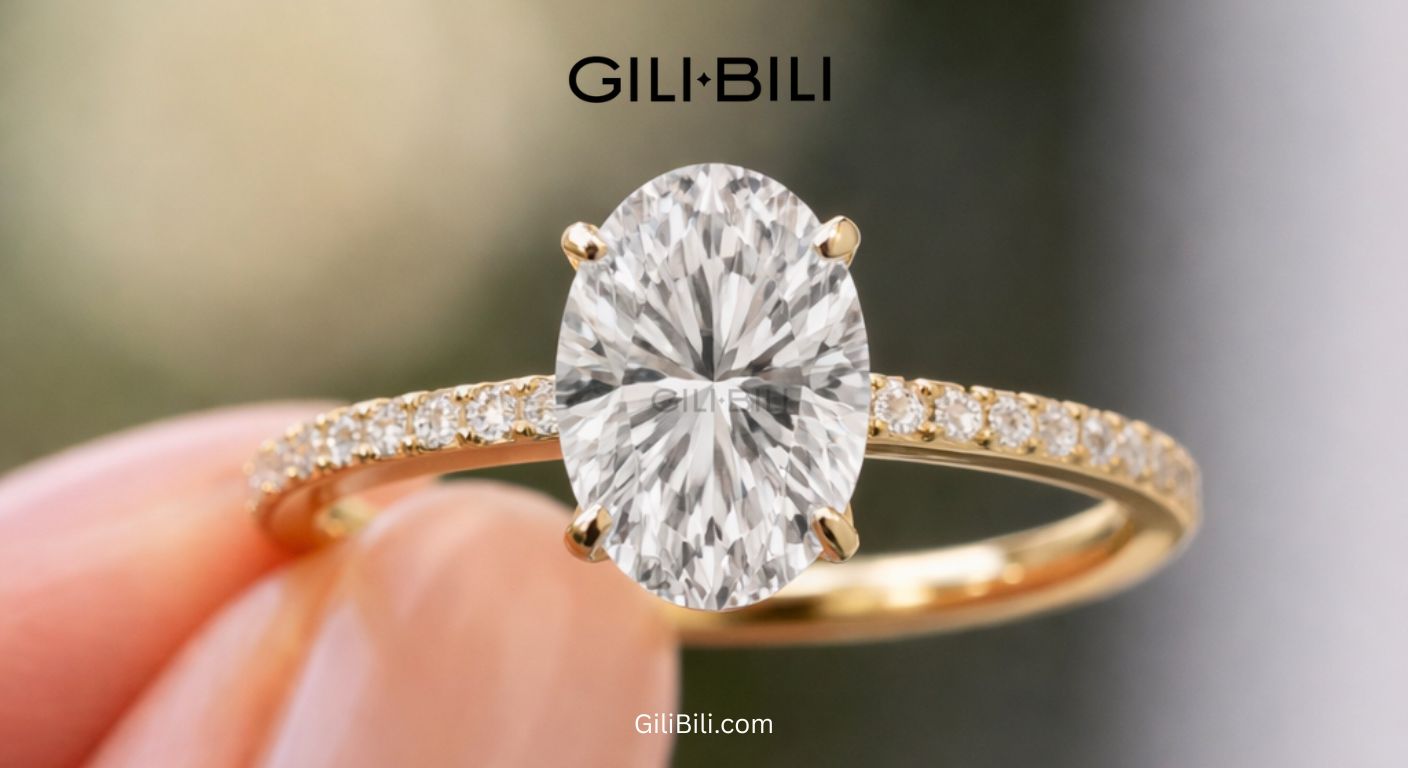
One of the first questions every buyer asks is: how much should you spend on an engagement ring? It is also one of the questions with the most outdated, misleading answers floating around the internet. The old “two months’ salary” rule was invented by a diamond marketing campaign in the 1940s. It has no basis in financial reality and no relevance to how people shop in 2026.
I’m Chintan Dhola, Co-Founder and Chief Jewelry Expert at GiliBili.com. With over 12 years in diamond manufacturing, grading, and jewelry production, I have guided thousands of buyers through the engagement ring budget conversation. In this guide, I am going to give you an honest, practical framework for deciding what to spend and show you exactly what a 2 to 3 carat premium lab-grown diamond ring actually costs in 2026.
Here is the short answer: in 2026, a premium IGI-certified 2 carat lab-grown diamond engagement ring starts at $2,500 to $3,000. A 3 carat starts at $4,500 to $5,000. D-F color, VS-VVS clarity, Excellent cut, set in solid 18K gold. Let’s talk about how to think about your engagement ring budget for 2026 the right way.

The “two months’ salary” rule for engagement rings was created by De Beers in a 1940s advertising campaign to sell more diamonds. It was never a financial guideline it was a marketing slogan. In 2026, the question of how much should you spend on an engagement ring has a much more sensible answer: spend what you can afford comfortably, without debt pressure, on a ring your partner will genuinely love.
The good news for buyers in 2026 is that lab-grown diamonds have completely restructured what “affording” a beautiful ring actually means. A natural 3 carat diamond with D-F color and VS-VVS clarity would cost $40,000 to $80,000. The identical quality in lab-grown starts at $4,500 at GiliBili. That is not a minor discount it is a fundamental reshaping of the entire engagement ring market.
So the first thing to decide is not how much to spend as a proportion of your salary. The first thing to decide is what size, quality, and style your partner actually wants and then find out what that costs in lab-grown. You will almost certainly be surprised at how achievable it is.
A realistic engagement ring budget in 2026 depends entirely on the carat weight and quality you want. Here is an honest, clear guide to what different budgets can achieve with premium lab-grown diamonds at GiliBili, all at D-F color, VS-VVS clarity, Excellent cut:
| Budget Range (USD) | What You Can Achieve | Carat Range | Quality Level |
|---|---|---|---|
| $1,500 – $2,000 | Premium 1ct lab-grown diamond ring in 18K gold | 1.0 ct | D–F color, VS–VVS clarity, Excellent cut |
| $2,000 – $2,500 | Premium 1.5ct lab-grown diamond ring in 18K gold | 1.5 ct | D–F color, VS–VVS clarity, Excellent cut |
| $2,500 – $3,000 | Premium 2ct lab-grown diamond ring in 18K gold | 2.0 ct | D–F color, VS–VVS clarity, Excellent cut |
| $4,500 – $5,000 | Premium 3ct lab-grown diamond ring in 18K gold | 3.0 ct | D–F color, VS–VVS clarity, Excellent cut |
| $5,000 – $5,500 | Premium 3.5ct lab-grown diamond ring in 18K gold | 3.5 ct | D–F color, VS–VVS clarity, Excellent cut |
| $6,000 – $6,500 | Premium 4ct lab-grown diamond ring in 18K gold | 4.0 ct | D–F color, VS–VVS clarity, Excellent cut |
| $8,000 – $9,000 | Premium 5ct lab-grown diamond ring in 18K gold | 5.0 ct | D–F color, VS–VVS clarity, Excellent cut |
These prices are for the complete ring: IGI-certified lab-grown diamond plus solid 14K or 18K gold setting. No hidden costs, no bait-and-switch. What you see is what you get.
Look at that table and think about what your partner actually wants. If they have talked about wanting a 3 carat diamond, the engagement ring budget conversation starts at $4,500 not $40,000. That is the single most important shift lab-grown diamonds have created for buyers in 2026.
Industry data shows that the average engagement ring spend in the US in recent years has been around $5,000 to $6,000. But averages can be misleading. Median spend the middle point where half of buyers spend more and half spend less is closer to $3,000 to $4,000 for the overall market.
What is more interesting is how the distribution is shifting in 2026. The growth of lab-grown diamonds has created a clear split in the market. Some buyers are maintaining their original planned budget and getting a significantly larger, higher-quality stone than they would have two years ago. Others are redirecting the savings toward other life priorities a home deposit, a honeymoon, emergency savings while still getting a beautiful ring.
Both approaches are completely valid. The point is that lab-grown diamonds give you a genuine choice that did not exist before. You are no longer forced to compromise on carat size because of budget. You can choose to spend less and get a great ring, or spend the same amount and get a significantly better ring than was previously possible at that price.
Rather than a fixed rule, here is the framework I walk every buyer through when they ask me how much they should spend on an engagement ring budget. It takes about five minutes and gives you a number that actually makes sense for your life.
Step 1: Find Out What Your Partner Actually Wants
This is the step most buyers skip and it is the most important one. Before you think about budget, find out what your partner genuinely wants in a ring. Do they care deeply about carat size? Do they prefer a specific shape? Is the metal more important to them than the diamond size? Have they saved rings on Instagram or Pinterest?
Many buyers spend significantly more than they needed to because they assumed their partner wanted a larger stone when they actually cared more about the setting design or the metal choice. Conversely, some buyers underspend because they did not realise how much their partner values carat size. Have the conversation directly or indirectly through trusted friends and family before you set a budget.
Step 2: Understand What That Actually Costs in Lab-Grown
Once you know what your partner wants, find out the actual cost of that specific ring in lab-grown quality. Use our price table above as a starting point. If they want a 2.5 carat oval in yellow gold, that is approximately $3,500 to $4,000 at GiliBili. If they want a 3 carat round in platinum, that is $4,500 to $5,000. These are real numbers, not estimates based on natural diamonds.
This step often completely reframes the budget conversation. Many buyers come to us expecting to spend $15,000 to $20,000 on a 3 carat diamond and are genuinely surprised to learn their target ring costs $4,500 to $5,000 in lab-grown quality. That surprise is always a good one.
Step 3: Decide What You Can Comfortably Afford
Comfortable is the operative word. An engagement ring should not create financial stress at the start of a marriage. There is no romantic merit in going into debt for a piece of jewelry, regardless of what any marketing campaign has told you. If your target ring costs $4,500 and you have $4,500 available without needing a loan, that is the right budget. If you can comfortably stretch to $6,000 and want a 3.5 carat, that is also valid.
What I always tell buyers: the ring you propose with is not a measure of how much you love your partner. It is a piece of jewelry. The relationship, the commitment, and the life you build together are the real measures. Buy a ring your partner will love that you can genuinely afford.
Step 4: Allocate Budget Across Diamond and Setting Intentionally
A common mistake is allocating almost all of the budget to the diamond and then settling for a setting that does not do it justice. At GiliBili, our settings are handcrafted in solid 14K or 18K gold and are included in the prices quoted above. But if you are building a custom ring with specific design details a hidden halo, pavé shoulders, a bespoke band understand that the setting has meaningful value and deserves proper budget allocation.
As a rough guide: the diamond should represent 70 to 80 percent of the total ring budget, with the setting taking 20 to 30 percent. This ratio ensures you get both an exceptional stone and a setting that honours it properly.

One of the most common questions I hear when buyers are deciding on an engagement ring budget is whether the jump from 2 to 3 carats is worth the extra cost. Here is the honest answer: the difference is visible, meaningful, and with lab-grown diamonds much more achievable than buyers expect.
| 2 Carat Diamond | 3 Carat Diamond | |
|---|---|---|
| Round diameter | ~8.1 mm | ~9.2 mm |
| Surface area | ~52 mm² | ~67 mm² (+29%) |
| Finger coverage | ~50% of avg. finger width | ~60–65% of avg. finger width |
| Visual impression | Glamorous, clear statement | Commanding, luxury presence |
| Price (lab-grown) | $2,500 – $3,000 | $4,500 – $5,000 |
| Price (natural est.) | $15,000 – $25,000+ | $40,000 – $80,000+ |
The 3 carat diamond has 29 percent more visible surface area than a 2 carat. That translates to a clearly noticeable size difference on the finger not subtle at all. If your partner has expressed a preference for a larger stone and your budget allows it, the 3 carat is a worthwhile step up. If the budget is tighter, a beautifully cut 2 carat in an elongated shape like oval or pear can look strikingly similar to a 3 carat round at a significantly lower cost.
If you have a fixed engagement ring budget and want to maximise the visual impact of the ring within that budget, here are the strategies that actually work:
• Choose an elongated diamond shape. Oval, pear, and marquise shapes cover significantly more surface area on the finger than a round diamond of the same carat weight. A 2.5 carat oval can look as large as a 3 carat round on the finger at a considerably lower price. This is one of the most effective visual upgrades available at any budget.
• Choose a thinner band. A 1.4 to 1.8 mm knife-edge or half-round band makes any diamond look larger by reducing the visual competition from the band itself. This costs nothing extra and creates a dramatically more modern look. The diamond appears to float on the hand.
• Add a hidden halo. A micro-pave ring of small diamonds set just beneath the center stone’s girdle adds perceived size without changing the ring’s profile from the top. A 2.5 carat oval with a hidden halo reads very close to a 3 carat in photographs and real-life viewing. The hidden halo adds a modest cost but delivers outsized visual value.
• Consider yellow gold over platinum. 18K yellow gold settings are priced similarly to white gold at GiliBili but the warm contrast against a D-F colorless diamond creates a dramatically more luxurious visual effect than a cooler metal. Yellow gold also photographs beautifully, which matters for engagement ring photos.
• Move from round to oval at the same carat weight. Within the same carat weight, an oval diamond looks approximately 10 to 15 percent larger than a round because its elongated shape covers more visual area on the finger. This is free same price, meaningfully larger appearance. It is one of the most consistently recommended changes I make to buyers working within a set budget.
If there is one piece of advice that will change how you think about your engagement ring budget, it is this: understand what lab-grown diamonds have done to the pricing of large, high-quality stones. The table below shows the comparison clearly.
| Carat Weight | Natural Diamond (D–F, VS–VVS, Excellent) | Lab-Grown at GiliBili (same quality) | Saving |
|---|---|---|---|
| 1.0 ct | $8,000 – $15,000 | $1,500 – $2,000 | ~85–90% less |
| 1.5 ct | $15,000 – $25,000 | $2,000 – $2,500 | ~88–92% less |
| 2.0 ct | $25,000 – $40,000 | $2,500 – $3,000 | ~90–93% less |
| 3.0 ct | $40,000 – $80,000 | $4,500 – $5,000 | ~90–94% less |
| 4.0 ct | $80,000 – $150,000+ | $6,000 – $6,500 | ~92–96% less |
Lab-grown diamonds are not imitations. They are real diamonds identical in physical, chemical, and optical properties to mined diamonds, graded to the same IGI standards, with laser inscriptions on every solitaire stone for full traceability. The difference in price reflects the cost of production, not the quality of the stone.
Learn everything about the science and certifications on our lab-grown diamonds page.

When you are deciding how much to spend on an engagement ring, quality allocation matters as much as the total number. Here is how to think about each quality factor and where your budget should go first:
• Cut first, always. Cut quality determines 80 percent of how a diamond looks in real life. An Excellent cut diamond at 2 carats will outperform a 3 carat diamond with a lower cut grade in every lighting condition. Never compromise on cut to get more carat weight. This is the one non-negotiable.
• Color D to F. At GiliBili we only offer D–F colorless diamonds for our engagement rings. This ensures the stone faces up brilliantly white in any setting and any light. In larger stones, color becomes more visible which is why we do not offer G–H or below at our quality tier.
• Clarity VS or better. At 2 to 3 carats, the larger face of the diamond makes inclusions more visible to the naked eye, particularly in step-cut shapes like emerald and asscher. VS1 or VVS clarity ensures you see clean, brilliant diamond with no distracting inclusions. We never recommend below VS clarity at these sizes.
• IGI certification with laser inscription. Every solitaire diamond at GiliBili comes with full IGI certification and laser inscription on the girdle. This is not optional it is your proof of quality, your insurance documentation, and your guarantee that you are getting exactly what you paid for.
At GiliBili, we build bespoke engagement rings at every price point from our budget range. Whether you are working with $2,500 for a beautiful 2 carat oval or $6,000 for a show-stopping 4 carat pear, our process is the same:
• We source your IGI-certified lab-grown diamond directly the exact shape, carat weight, color (D–F), and clarity (VS–VVS) your partner wants
• Our design team creates a detailed CAD rendering of the complete ring before anything is made
• Every ring is handcrafted in solid 14K or 18K gold (yellow, white, or rose) or platinum
• Free worldwide insured shipping and 30-day return policy on every order
Browse our engagement ring collection, start a custom ring design, or use our ring size guide to get your partner’s measurement sorted before you order.
Is the two months' salary rule still relevant in 2026?
No. The two months’ salary rule was created by De Beers in a 1940s advertising campaign and has no basis in sound financial planning. In 2026, the right amount to spend on an engagement ring is the amount you can afford comfortably, without debt, for a ring your partner will love. With lab-grown diamonds making larger, higher-quality stones far more affordable, the old rule is even less relevant than before.
What is the average engagement ring spend in 2026?
Industry data places average engagement ring spend in the US between $5,000 and $6,000, though median spend is closer to $3,000 to $4,000. What matters more than the average is what your specific target ring actually costs. With lab-grown diamonds, $3,000 to $5,000 buys a 2 to 3 carat premium ring that would have cost $25,000 to $80,000 in natural diamonds.
How much does a 2 carat lab-grown diamond engagement ring cost?
At GiliBili, a premium IGI-certified 2 carat lab-grown diamond engagement ring in D–F color, VS–VVS clarity, Excellent cut, set in 14K or 18K gold starts at $2,500 to $3,000 (£2,050 to £2,460). Explore our engagement ring collection for current styles.
How much does a 3 carat lab-grown diamond engagement ring cost?
At GiliBili, a premium IGI-certified 3 carat lab-grown diamond engagement ring in D–F color, VS–VVS clarity, Excellent cut, set in 14K or 18K gold starts at $4,500 to $5,000 (£3,690 to £4,100). An equivalent natural diamond at this quality level would typically cost $40,000 to $80,000 or more.
Should I go into debt for an engagement ring?
I would strongly advise against it. An engagement ring should be a joyful expression of your commitment not a source of financial stress at the start of your marriage. With lab-grown diamonds making 2 and 3 carat premium rings available for $2,500 to $5,000, there is very rarely a need to finance an engagement ring in 2026. If the ring your partner wants costs more than you can comfortably afford today, have an honest conversation and consider sizing up later when finances allow.
Is it worth spending more on a bigger diamond or a better setting?
Both matter, but the diamond is more important for long-term satisfaction. A stunning 2.5 carat oval in a simple solitaire setting will outlast and outperform a 1 carat diamond in an elaborate halo in terms of long-term desirability. That said, the setting shapes how the diamond is presented every single day. Allocate roughly 70 to 80 percent of your total budget to the diamond and 20 to 30 percent to the setting. Never let the setting be an afterthought.
The honest answer to how much should you spend on an engagement ring in 2026 is: spend what you can comfortably afford, on the ring your partner genuinely wants, without financial stress. And with lab-grown diamonds available at GiliBili from $1,500 for a 1 carat up to $4,500 to $5,000 for a premium 3 carat, that ring is far more achievable than most buyers expect when they start the process.
The engagement ring budget conversation in 2026 is fundamentally different from even five years ago. Lab-grown diamonds have rewritten the rules. You no longer have to choose between quality and size. You no longer have to compromise on the dream ring because of the price of natural diamonds. The ring your partner has always wanted is probably much closer to your budget than you think.
Connect with us on WhatsApp: +91 8200212331 (instant reply)
Email: hello@gilibili.com
We help with loose lab diamonds, custom jewelry, engagement rings, and fancy color lab diamonds. Tell us your budget and your vision we will show you what is possible.


