Cart
0
Checking your FREE GIFT offer...


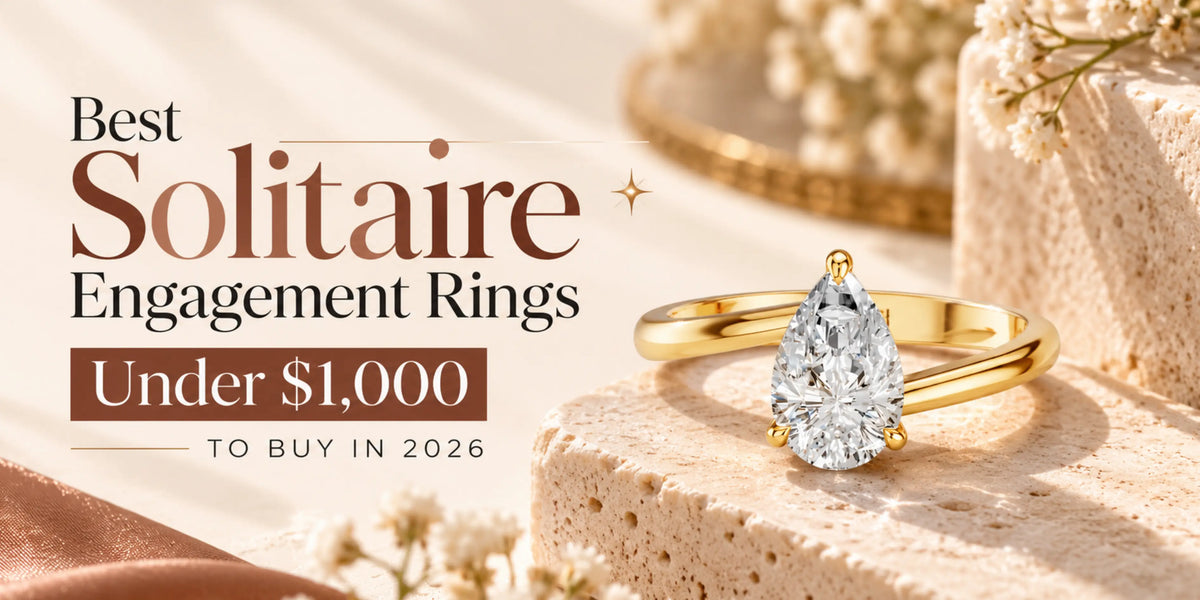
A solitaire engagement ring puts one diamond front and center, so the details around it do the talking: the diamond's shape, the band design, the setting and the metal. With lab grown diamonds, a budget under $1,000 can now cover modern designs such as flowing bypass bands, sculpted waves, split shanks and bezel frames, rather than only a plain straight shank.
This guide covers 10 GiliBili lab grown engagement rings, using prices and specifications from the product pages checked in October 2026. Nine of them have starting prices between $400 and $800 in 925 silver. The tenth, the Pear Hidden Halo, starts at $1,090 and is included as a step-up pick. Every ring lists a D-E color, VVS/VS clarity lab grown center diamond with an IGI certificate.
If you want a lab grown solitaire engagement ring under $1,000, the lowest starting price is $400, shared by the Pear Bypass Prong, Modern Wavy Pear and Round Classic rings. In 925 silver, several designs reach 1.50 CT within budget, including the Pear Bypass Prong ($815), Round Bypass ($820) and Oval Twisted Bypass ($830). The 14K and 18K gold versions of these designs start above $1,000.
Shape sets the character of a solitaire more than any other detail. Round brilliants offer the most familiar sparkle, while oval and pear shapes have a longer outline that can make a finger look longer. Emerald cuts trade fiery sparkle for clean, mirror-like step-cut lines.
Four shapes appear in this guide: round, pear, oval and emerald. Pear is the most heavily represented, with five of the ten rings, so there is a good range of pear band styles to compare.
On a solitaire, the band is where the design personality comes from. A bypass band curves past itself and wraps around the center stone. A wave or wavy band uses flowing, contoured lines. A split shank divides into two strands near the stone, and a hidden halo adds small accent diamonds beneath the center while keeping a clean top view.
Prongs hold the diamond with small metal claws and leave more of the stone exposed. This is the more open look, and most of the rings here use it. A bezel surrounds the diamond with a smooth metal rim, giving a lower, more protected profile. The Round Classic and Split Shank rings are bezel set.
Carat weight is worth comparing, but shape matters too, because pear, oval and emerald cuts can look larger or smaller than a round of the same weight. Within this list, the listed center sizes run from about 0.50 CT to 2.00 CT on most rings, with the hidden halo styles starting at 1.00 CT.
All ten product pages list the center diamond as D-E color and VVS/VS clarity, with an IGI diamond certificate. Because that grading is the same across the group, the choice comes down to shape, design, size and metal rather than quality tiers.
This is the detail that matters most for the budget. Each starting price on GiliBili is for 925 sterling silver. Gold costs more: across these rings, the lowest 14K gold starting price is $1,015, and 18K gold starts higher. If you want gold, plan for a budget above $1,000.
Sterling silver is softer than gold and can darken over time, though GiliBili notes that a polishing cloth restores it. For many buyers, silver is a sensible way to get a larger diamond within a fixed budget.
The rings below follow the order of the product list supplied for this guide. Prices and specifications reflect the GiliBili product pages checked while preparing this article and may change over time.
Two bands curve past each other and wrap around the center diamond, so the ring reads as a classic round solitaire with a soft, flowing movement. The slim 1.70 MM shank keeps the profile light and lets the diamond lead.
Best forAnyone who loves a round brilliant but wants the band to feel more contemporary than a plain straight shank.
View ProductThis is the most sculpted band in the group. The shank swells to about 3.5 MM and tapers to 2.0 MM in a wave-like contour, which gives the pear center a visible base rather than a thin wire underneath it.
Best forShoppers who want a bolder, more architectural band and are happy with a 0.50 to 1.00 CT center within budget.
View ProductOne of the lowest entry prices in the list, paired with a pear center and a bypass band that curves around the stone. The open prong setting leaves most of the diamond exposed to light, and the teardrop shape tends to make a finger look longer.
Best forBudget-minded buyers who want a pear solitaire and the option of stretching to 1.50 CT in silver.
View ProductA second pear bypass design, with a slightly wider 1.90 MM shank and sweeping lines that read a little more sculptural than the version above. Having two pear bypass options lets you compare band weight and proportion before choosing.
Best forPear lovers who want a bypass band with a touch more presence on the finger.
View ProductThe band twists as it moves toward the oval center, adding depth that a straight bypass does not have. At 2.00 MM, it is also one of the sturdier shanks in the selection, and the oval shape keeps the sparkle of a round with a longer outline.
Best forOval fans who want an engagement ring with a bit of visual texture and a slightly stronger band.
View ProductA flowing wavy band carries the eye up to a prong-set pear. It is a lighter, more fashion-forward take on the wave idea than the Pear Shaped Wave ring above, and it shares the $400 entry price.
Best forAnyone who wants a modern, softly curving band at the lowest price tier in the list.
View ProductThis ring starts at $1,090, slightly above the $1,000 mark, because its smallest listed center is 1.00 CT. It is included as a step-up pick. Strictly speaking, it also carries small hidden accent diamonds, so it is a solitaire-style ring rather than a pure solitaire.
Why it stands outSmall round diamonds sit beneath the pear center, adding sparkle from the side while the top view stays clean and solitaire-like. It is the most luxurious look of the ten, with larger center sizes available if the budget stretches.
Best forShoppers who want a solitaire profile with extra side sparkle and can go modestly past $1,000.
View ProductClean step-cut lines and a hidden halo make this the most formal ring in the selection. You start at a full 1.00 CT center in silver for $800, which is a lot of diamond for the price, but the next size up (1.50 CT) moves past $1,000.
Best forBuyers who prefer geometric emerald-cut elegance and want a 1.00 CT center without going over budget.
View ProductThe only ring here with a 0.75 CT option, and it has the most size choices under $1,000. A smooth bezel frame surrounds the round diamond, which gives a low, secure profile with a clean modern look.
Best forEveryday wearers, active hands and anyone who wants the simplest, most protected round solitaire in the list.
View ProductThe band divides into two strands as it approaches the center stone, adding detail at the shoulders while the bezel keeps the diamond secure and low. It combines two popular ideas, a split shank and a protective frame, in one ring.
Best forShoppers who want something distinctive from the side without giving up the practicality of a bezel.
View Product| Ring | Starting Price | Center Shape | Style | Listed Carat Range | Largest Silver Size Under $1,000 |
|---|---|---|---|---|---|
| Round Bypass | $405 | Round | Bypass band | ~0.50–2.00 CT | 1.50 CT ($820) |
| Pear Wave | $460 | Pear | Wave band | ~0.50–2.00 CT | 1.00 CT ($785) |
| Pear Bypass Prong | $400 | Pear | Bypass band | ~0.50–2.00 CT | 1.50 CT ($815) |
| Pear Modern Bypass | $415 | Pear | Bypass band | ~0.50–2.00 CT | 1.50 CT ($885) |
| Oval Twisted Bypass | $415 | Oval | Twisted bypass | ~0.50–2.00 CT | 1.50 CT ($830) |
| Modern Wavy Pear | $400 | Pear | Wavy band | ~0.50–2.00 CT | 1.00 CT ($775) |
| Pear Hidden Halo | $1,090 | Pear | Hidden halo | ~1.00–5.00 CTW | None (starts at $1,090) |
| Emerald Hidden Halo | $800 | Emerald | Hidden halo | ~1.00–5.00 CTW | 1.00 CT ($800) |
| Round Classic Bezel | $400 | Round | Classic bezel | ~0.50–1.50 CT | 1.50 CT ($870) |
| Split Shank Bezel | $485 | Oval | Split shank | ~0.50–2.00 CT | 1.00 CT ($810) |
A $1,000 budget buys a meaningful amount of lab grown diamond if you choose 925 silver. At 1.00 CT, nine of the ten rings here fall between $655 and $810 in silver. The Pear Bypass Prong is the least expensive at $655, and the Split Shank is the highest of the nine at $810.
At 1.50 CT, five rings stay under $1,000: Pear Bypass Prong ($815), Round Bypass ($820), Oval Twisted Bypass ($830), Round Classic ($870) and Pear Modern Bypass ($885). The others move above $1,000 at that size. At 2.00 CT, every ring in the list is above $1,000 in silver.
Gold changes the picture. The lowest 14K gold starting price is $1,015, so a gold ring from this list sits above a $1,000 budget even at the smallest listed center size. If you prefer gold, consider choosing silver now or planning a slightly higher budget.
One more note on sizing: several of the product pages state that GiliBili does not resize rings itself, so confirm your ring size with the brand's size guide before ordering.
Lab grown diamonds are real diamonds produced in a controlled laboratory environment. They are not diamond simulants such as cubic zirconia. GiliBili's product pages identify the center stones in these rings as lab grown diamonds and list an IGI certificate for each.
For a solitaire, where one stone carries the whole design, that can mean a larger or higher-grade center within the same budget. A 1.00 CT or 1.50 CT center is realistic here, which would be harder to reach at this price with a mined diamond.
Choose a bypass band if you want movement and a story-like symbol of two paths joining. The Round Bypass, Pear Bypass Prong, Pear Modern Bypass and Oval Twisted Bypass rings all use this idea in different shapes.
Choose a wave or wavy band for a more sculptural, fashion-forward look. The Pear Shaped Wave and Modern Wavy Pear rings both use flowing contours, with the Pear Shaped Wave carrying the wider, tapering band.
Choose a bezel ring if practicality matters most. The Round Classic and Split Shank rings have a smooth metal rim around the diamond, which gives a low profile for everyday wear.
Choose a hidden halo if you want extra sparkle without changing the solitaire silhouette from above. The Emerald Hidden Halo fits a $1,000 budget at 1.00 CT in silver, while the Pear Hidden Halo starts slightly higher.
Yes. Nine of the ten GiliBili rings featured here have starting prices between $400 and $800 in 925 silver, with D-E color, VVS/VS clarity and an IGI certificate listed on the product pages. Gold versions of these designs start above $1,000, and the Pear Hidden Halo starts at $1,090.
It depends on the style you prefer. This guide covers bypass bands in round, pear and oval, wave and wavy pear designs, hidden halo rings, a classic round bezel, and a split shank bezel ring.
Three rings share the lowest starting price of $400: the Pear Shape Lab Diamond Bypass Prong Setting Ring, the Modern Wavy Pear Shaped Ring and the Round Shaped Classic Ring.
In 925 silver, five of the ten rings reach 1.50 CT within budget: the Round Bypass ($820), Pear Bypass Prong ($815), Pear Modern Bypass ($885), Oval Twisted Bypass ($830) and Round Classic ($870). Most of the others reach 1.00 CT. At 2.00 CT, every ring in the list is above $1,000.
Generally no. The lowest 14K gold starting price across these rings is $1,015, and 18K gold starts higher. The under-$1,000 prices in this guide refer to 925 silver at the sizes noted for each ring.
It can be a practical choice. GiliBili states that its pieces are made in solid gold or sterling silver rather than plated. Sterling silver is softer than gold and can darken slightly over time, though a polishing cloth restores it. Many buyers use silver to get a larger diamond within budget.
Yes. Each product page lists an IGI diamond certificate, and the center diamonds are listed as lab grown with D-E color and VVS/VS clarity.
A bypass ring has band ends that curve past each other and wrap around the center stone instead of meeting in a closed circle. Several rings here use a bypass design, including the round, pear and oval versions.
Prongs hold the diamond with small metal claws and leave more of the stone open to light. A bezel surrounds the diamond with a smooth metal rim for a lower profile and extra protection. The Round Classic and Split Shank rings in this guide use bezel settings.
They look like solitaires from above, but small round accent diamonds sit beneath the center stone. The Pear and Emerald Hidden Halo rings list roughly 0.10 to 0.15 CTW of those accents, so they are best described as solitaire-style rings.
Under $1,000, a lab grown solitaire engagement ring does not have to mean a basic one. This GiliBili selection includes round, pear, oval and emerald-cut centers in bypass, wave, split shank, hidden halo and bezel designs, with D-E color, VVS/VS clarity and an IGI certificate listed throughout.
The main trade-off is metal. The sub-$1,000 prices are for 925 silver, and gold versions start above that mark. If you stay with silver, you can reach 1.00 CT on nearly every ring and 1.50 CT on five of them. Choose the band style that matches your taste first, then check the carat size and metal that fit your budget.
Before ordering, compare the exact metal, carat size, shank width and current price of your preferred design. Product configurations and prices can change, so the product page should always be your final reference.
Ready to find your lab grown solitaire engagement ring?
Browse GiliBili Solitaire Rings


